Blogue d'un québécois expatrié en Angleterre. Comme toute forme d'autobiographie est constituée d'une large part de fiction, j'ai décidé de nommer le blogue Vraie Fiction.
There is one fundamental truth about English literature: you never read enough George Orwell. There is another fundamental truth about English literature: not enough people read Orwell. There is yet another fundamental truth about English literature, a corollary of the first two: too many idiots refer to Orwell even though they haven't read a single one of his books and only know the title of one. In other words, "Orwellian" has become a buzzword uneducated pedants and political wannabe Nostradamuses, generally right wing ones. So anyway, I bought this book at £1.00, because that's a great read at bargain price.
Something I remembered today, thanks to my many Facebook likes: George Orwell was born today, the 25th of June, 1903. The great George Orwell, who, as Christopher Hitchens said, "spoke the truth". I recently read Down and Out in Paris and London, which made me rediscover his genius. Yesterday I was in London, which I saw with new eyes. Of course, when I see London, a part of me sees it through the eyes of Winston Smith, from his most famous novel. Modern day London is very different than the nightmarish one of Orwell's cautionary take, still, you can indulge in a bit of projection. His name and his words have sadly been used in vain numerously and are still used now gratuitously. Many speak of Orwell, not many really read him, or understood him. Christopher Hitchens did and so did Anthony Burgess in the essay part of 1985. I would strongly recommend that people would come back to Orwell's writing, not only 1984 and Animal Farm, but also his other works. I have only recently discovered them, but I intend to preach by example.
I am about to finish Down and Out in Paris and London. I only have a few pages left (and I know it took so much more time than it should have had, since the book is quite short). I blogged about it here. George Orwell amazes me, because, as Christopher Hitchens said, he spoke the truth. Not merely because he was sincere, but because he was so darn accurate about life. I have decided to add here some quoted from the book, that stuck to my mind. Orwell, indeed, spoke the truth:
"I am glad that this happened, for it destroyed one of my illusions, namely, that Frenchmen knew good food when they see it."
"I think that one should start by saying that a plongeur is one of the slaves of the modern world."
"The mass of the rich and the poor are differentiated by their incomes and nothing else, and the average millionaire is only the average dishwasher dressed in a new suit."
"A beggar, looked at realistically, is simply a businessman, getting his living, like other business men, in the way that comes to hand. He has not, more than most modern people, sold his honour; he has merely made the mistake of choosing a trade at which it is impossible to grow rich."
"It is curious how people take it for granted that they have a right to preach at you and pray over you as soon as your income falls below a certain level."
There would be more to quote. His observations on religious charities and church people are brilliantly corrosive without ever going in the territory of unfair hostility. So yes, I will not stress it enough, read it.
"And there is another feeling that is a great consolation in poverty. It is a feeling of relief, almost of pleasure, at knowing yourself at last genuinely down and out. You have talked so often of going to the dogs, and you have reached them, and you can stand it. it takes off a lot of anxiety."
I am reading Down and Out in Paris and London at the moment, among the pile of books I read in the same period of time. So far I am in the Paris part. I don't read enough Orwell, just like I don't read enough Nabokov.We forget that he wrote more than Animal Farms and 1984. This is why I bought this book and decided to read it. Christopher Hitchens, who was a great admirer of Orwell, said that he "spoke the truth." This is how I feel reading it, not merely seeing a reality, but seeing the universal truth that is at the core of it. Poverty has never felt so true. Anyway, I wanted to quote Orwell's work without using his two most famous books, this struck me when I read it.So I decided to share it.
''It was a bright cold day in April, and the clocks were striking thirteen.''
I have no reason to quote the opening line of 1984. Well, yes I do, I have two: 1)it is still April and I had wanted this line which pictures the month in a nutshell on the blog for a while and 2)it is a funny line, for the incipit of such a grim novel. Read it again if you haven't notice it.
"Oranges and lemons,
Say the bells of St. Clement's.
You owe me five farthings,
Say the bells of St. Martin's.
When will you pay me?
Say the bells of Old Bailey.
When I grow rich,
Say the bells of Shoreditch.
When will that be?
Say the bells of Stepney.
I do not know,
Says the great bell of Bow.
Here comes a candle to light you to bed,
And here comes a chopper to chop off your head!"
I had this famour nursery rhyme in the head today. Well, not the whole thing, just the beginning... and the end. I know it, of course, from 1984. I know very little about traditional English nursery rhymes. You can read more about its history here. According to Wikipedia, it represents "the near-complete eradication of shared culture". I just think it is deliciously sinister. Like many nursery rhymes and old fairy tales, there is something simply terrifying about those lines. Like an old hidden threat about to bring doom to a seemingly idyllic environment. Orwell understood this well. The orange in A Clockwork Orange, was supposed to signify human (orang is "man" in Malay). I always wondered if it had not been inspired by this nursery rhyme and by its presence in Orwell's classic. Anyway, read it aloud and see if you shiver. I know I do.
I mentioned it before, I wish I could go to Manchester sometimes. But this time I am green with envy. I learned from the Anthony Burgess Foundation that many books of Anthony Burgess will be (re)launched on the 3rd of December, including 1985 (an study of George Orwell's 1984), Tremor of Intent, A Dead Man in Deptford and more. I own many of them, I have read most of them, but many of those only in their French translations. And they will be there, available again after a long absence from the bookshelves. I wanted to go book hunting, that would have been the perfect opportunity. In the meantime, I would have made a long overdue pilgrimage. Instead, it is going to be everyday life here on the 3rd of december, just an ordinary Friday.
"To the future or to the past, to a time when thought is free, when men are different from one another and do not live alone-to a time when trust exists and what is done cannot be undone: From the age of uniformity, from the age of solitude, from the age of Big Brother, from the age of doublethink-greetings!"
I have been wanting to write this post for ages, I have been thinking about it over and over again, looking for the right words. Where to start? I think I know where to finish, but there is a lot to tell. Oh well, let's try.
It is a beautiful day today, just like it was eight years ago when I woke up. I have blogged about the events of 9/11 last year. Recently, I reread it, trying to find the right words again. Revisiting my first post on the 9/11 terrorist attacks, I discovered that I did not talked much about my experience of it, but mainly about what happened before and after. it is true that I lived 9/11 the way most people on the planet lived it: as a far away witness, looking at it from a safe distance, through the TV cameras. The emotional impact was still tremendous. As I said in the first post, the 21st century, and indeed the new millennium, was started on September 11, 2001. Our time changed, because our perception of time, of history, of our place in history, changed.
I remember watching the news almost non-stop that day, I remember the most trivial things, like I ate chocolate cake as a dessert that evening, I know who I talked to in the bar that night, I think I can remember the taste of the beer. I also remember meeting my neighbour on my way to the bar. She was and is still a devout Christian, of the evangelical type. She was like me outraged by what happened. But underneath the anger I could perceive Christian fatalism and maybe even masochism. She mentioned that 9/11 had been prophesied in the Bible, I did not contradict her (I had made such "prophecies" myself, regarding the jihad and an Islamist attack, so that would make me just as good as any Jewish prophet I guess). She said, and I remember this vividly: "Guillaume, we have to admit that there is something fundamentally evil with man". I concurred, thinking she was referring to the Islamists, but she proved she was thinking of more people, carrying on: "I mean, no wonder, when one see all those girls wearing barely anything in cégeps, being all flirtatious and promiscuous, that our society is shockingly immoral, and that God is most likely offended." I could not believe that. I did not grow angry, although that could have been a Hell of a reason to be. As I like and respect my neighbour, I simply stated that our "decadent" Western society was fine, I was perfectly happy with it and that I don't think it was a time for compromises. What had happened was inexcusable. Al Qaeda terrorists and their mad devotion were responsible for the death of innocent people, not our way of life or our secularism.
I quoted George Orwell at the beginning of this post for a reason and it is not a gratuitious one. I do not believe one minute that Bush is Big Brother, actually unlike many of the Bush haters I don't think he could have been much of a dictator: he lacks the intelligence. I do, however, believe that his God, the God of the religious right who supported him is a sort of Big Brother, just like the God of Bin Laden and the Muslim fundamentalists. When the disgusting Jerry Falwell claimed that God had let the enemies of America attack it because of the way gays, feminists and other "liberals" were living their life, he was in essence picturing himself as a Christian mullah. It was probably the most tragic thing about 9/11: freedom was attacked in the most obvious way, but the people who were supposed to defend freedom did not do much. Freedom was attacked, but they failed to defend it. After the madmen threw planes in the Twin Towers because they were against sex, homosexuality, abortion, alcohol, pork, atheism, some bigots who had nothing against eating pork chops went after them, disregarding in the meantime Western values. There was Guantanamo and Iraq, of course, but also the borderline esoteric practice of Christianity of Bush and co being promoted in the US and indeed the West, while here in England, the US' closest ally, the sharia law is being applied and we can see women wearing the completely covering Islamic veil even in suburbia. Oh yes, and I have a friend in Afghanistan, going after the Talibans but in the meantime protecting a corrupted, impotent regime.
Like last year, I think it is in order to commemorate that day with The future by Leonard Cohen. It's a great song, pretty good clip too, although it was stupidly censored, as if the mentions of crack and anal sex could be a sign of moral decadence. I don't think so, but our weakness to defend Western civilisation and its ideals certainly shows that we do not find the secular values, the secular morals of Western civilisation very precious. We are besieged by Islamic fundamentalism but cursed by our own Christian puritanism. I just hope that what Cohen wrote will end up being a simple warning and not a prophecy, and that freedom and Western culture did not get buried in the graveyard of ash, concrete and steel that are the ruins of the World Trade Center. In the meantime, I am contemplating the past and it feels like an abyss that opened and that could swallow our hopes.
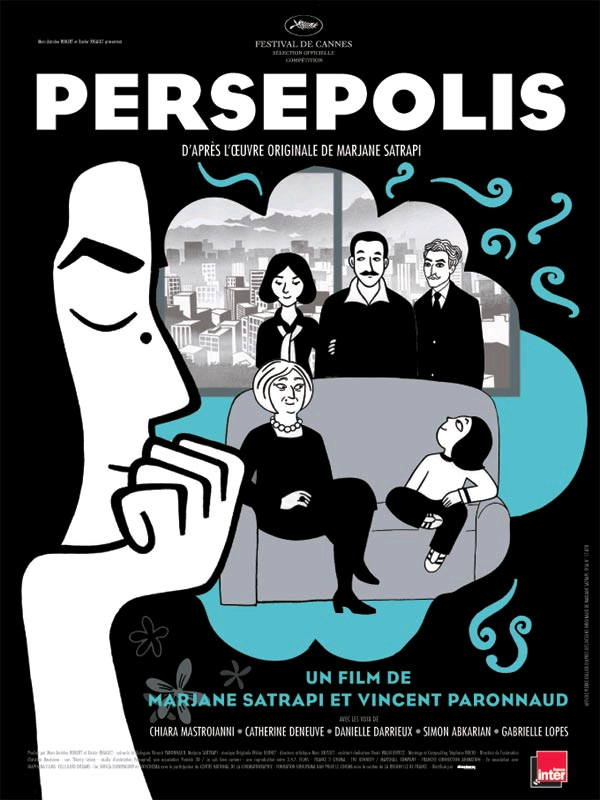
I am reading Persepolis by Marjana Satrapi at the moment, it's a really great autobiographical graphic novel. It is also a reflexion on history. Persepolis tells the story of a girl growing up in Iran during the Islamist revolution. But through her eyes, it is the story of a people who cannot free itself from tyranny (the monarchy, then the ayatollahs) and ultimately cannot find peace. It is also about the corrosive nature of ideologies, as they turn people into unloving, violent zealots. Reading it, I am thinking the regimes in Iran (either monarchy or Islamist republic) look a lot like the one of Oceania in Orwell's 1984. Like Ingsoc, the regimes in Persepolis use double thinking, patriotism and religion to try to control every aspect of individual life, including sexuality and love. Unlike Ingsoc (so far anyway), it does not as far as penetrating the consciousness of the citizens. Not all of them anyway, as many people do criticize the regime, even revolt, sometimes openly. That said, to see that a country that was not short of free thinkers and smart, open-minded people got opressed so easily is shivering in itself. And it makes me think that we Westerners are not out of danger in that regard. I mentioned on this blog in the past our own brand of fundamentalism and they are also more than eager to control us, to impose their system of beliefs on us. We should show vigilance, but when I see nowadays that Big Brother is for the young generation a vulgar, trashy game show, I wonder if there is really hope. If the real Big Brother shows up, who will oppose any kind of resistance?
Joseph Facal l'explique avec éloquence. Michel Vastel en a parlé aussi. Je déteste cordialement Michaëlle Jean depuis qu'elle est devenue gouverneure générale et qu'elle a pratiquement renié le Québec. Son attitude condescendante envers le Québec et la manière dont le gouvernement fédéral l'a instrumentalisée dans son opération de récupération de l'histoire du Québec est proprement dégoûtante. je ne sais pas si Facal l'a voulu, mais je crois qu'il fait allusion à ça (voir les premiers instants du film):
Je ne veux pas crier au loup, le Canada n'est après tout pas l'Océania et malgré la contradiction que représente la gg le système politique canadien n'est pas l'Ingsoc, loin s'en faut, , mais on y a fâcheusement tendance à vouloir gommer le passé et le reconstruire de manière à ce que ça plaise aux fédéralistes. Et ça demeure une façon très orwellienne de voir l'histoire.
I promised an entry about phobias, so here it is. As some of you know might know, I am slightly phobic about rats. I mean, I really hate those disgusting rodents. I don`t know why, just writing about them makes me shiver. I even got nervous watching Ratatouille!
Maybe I got phobic about rats when I first watched 1984 (the adaptation by Michael Radford, when I was 12, years before I read Orwell's novel). The the first memory I have of being utterly scared of rats was when Winston Smith got in Room 101. That scene haunts me still.
Québécois originaire du Saguenay expatrié en Angleterre à cause d'un mariage avec une Anglaise.
Quebec expatriate living in England because he married an English woman.
 There is one fundamental truth about English literature: you never read enough George Orwell. There is another fundamental truth about English literature: not enough people read Orwell. There is yet another fundamental truth about English literature, a corollary of the first two: too many idiots refer to Orwell even though they haven't read a single one of his books and only know the title of one. In other words, "Orwellian" has become a buzzword uneducated pedants and political wannabe Nostradamuses, generally right wing ones. So anyway, I bought this book at £1.00, because that's a great read at bargain price.